A kabbalistic readingLectura cabalística
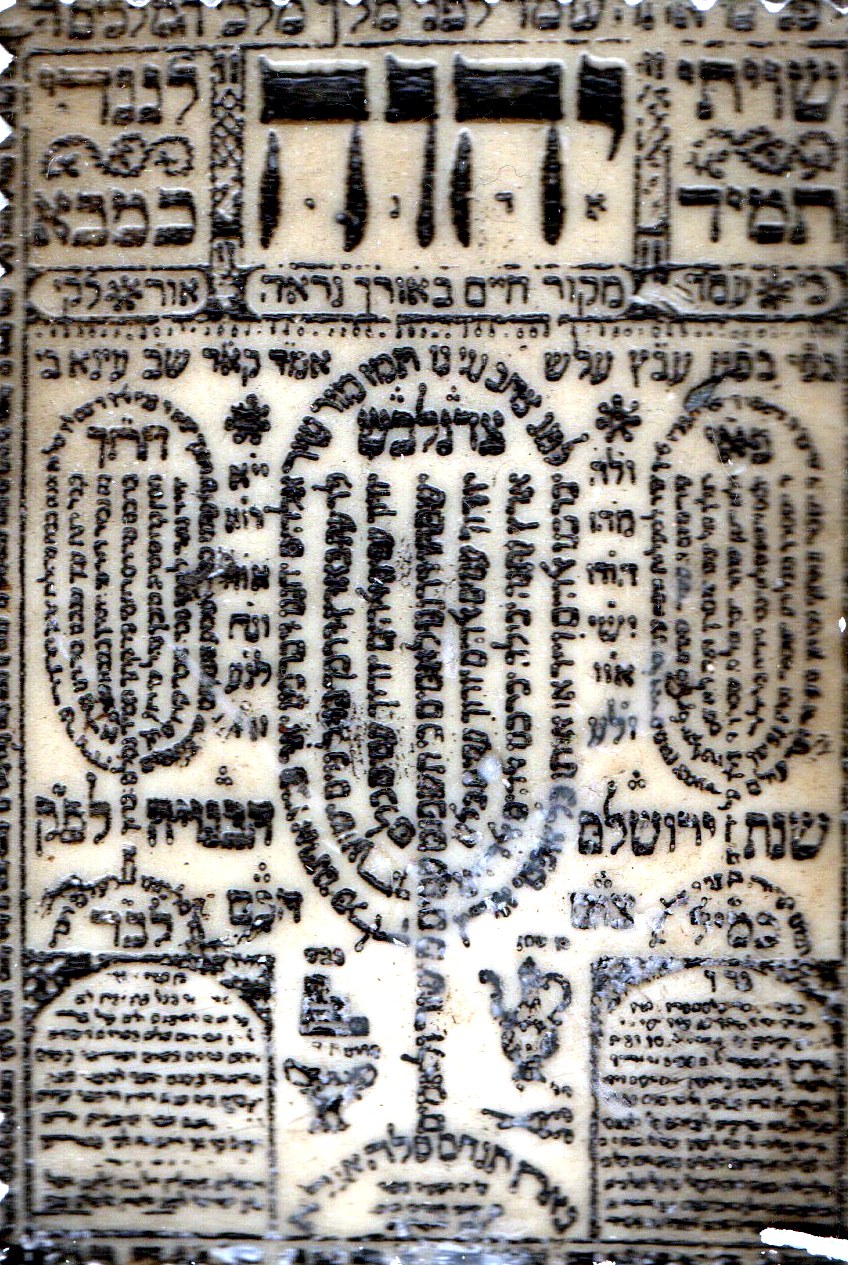
A shiviti is not a pious illustration. It is an instrument of contemplation, and this one is also a shield. Both functions come from the same idea: what one places before the eyes orders what is inside, and what is ordered inside lets no harm in. The sheet is built as a descent of light, from top to bottom, and as a closed perimeter, from outside to inside. It is best read in that order.
The header: the warning
The first line is not a verse but a Talmudic warning: “Know before Whom you stand.” It sits where the crown, Keter, would sit, because it is the condition for everything else. Without that awareness the rest of the sheet is letters. With it, each letter becomes what Kabbalah calls a kavanah, a directed intention.
The Name and its union
יהוה · יאהדונהיThe large Tetragrammaton is not pronounced. Beneath its letters the sheet interleaves small letters that point to Adonai. The pairing, יאהדונהי, is the most repeated yichud of Lurianic Kabbalah: the union of the Name that cannot be said with the Name that is said; of the sefirah Tiferet, the centre of the tree, with Malkhut, its lowest point, the kingdom, the receiver. The one who looks at the amulet performs that union with the eyes. This is the central meditative act, and everything else hangs from it.
The fountain of life
כי עמך מקור חיים באורך נראה אורPsalm 36:10 is placed just below the Name and just above the menorah, and that position is its commentary. “With You is the fountain of life; in Your light we see light”: the light descends from the Name to the lampstand. In the language of the sefirot, what is above is the source (Chokhmah, wisdom, from which life flows) and the seven-branched menorah is the vessel receiving that light, the seven lower sefirot from Chesed to Malkhut. The amulet draws the tree, literally.
The menorah and Psalm 67
After its title the psalm has seven verses, and each forms one branch. It has forty-nine words, seven times seven, the number of the days of the Omer between Passover and Shavuot and of the “gates” of Binah, understanding. Its central verse, the fifth, has exactly forty-nine letters, which is why it runs down the trunk: the trunk is the axis, the middle pillar, and it ends at the base with the word “Selah.” Tradition says David carried this psalm on his shield in this shape, and that looking at it daily as a menorah opens livelihood and closes the way to the enemy.
צדנלב״שAbove the central flame stands a Name of six letters: the acrostic of the gift Jacob sends with his sons to the ruler of Egypt, “a little balm, a little honey, gum, ladanum, pistachios and almonds” (Genesis 43:11). It is a Name of grace: used to be well received by those in power and, in the Lurianic tradition, as shelter in time of plague, meditated by reciting the verse at sunrise and sunset. Placed at the crown of the menorah of livelihood, it reverses the direction of the journey: what Jacob sent down to Egypt, the one who prays sends up, as an offering over the flame.
The Name of 42 letters: the ladder
אבג יתץ · קרע שטן · נגד יכש · בטר צתג · חקב טנע · יגל פזק · שקו ציתAround the menorah, in groups of three letters, runs the Name by which, according to the Talmud, the world was created (Kiddushin 71a). It is the acrostic of Ana bekoach, the seven-line hymn of forty-two words said when welcoming Shabbat and when counting the Omer. Each of the seven lines corresponds to one of the seven lower sefirot and to a day of the week. The second group, קרע שטן, reads transparently: “tear down the adversary.” Set around the lampstand, the Name acts as a fence: the force that separates what is created from what must not enter.
The ovals: the Name of 72
The two side ovals hold the Shem ha-Meforash of seventy-two triplets of letters, thirty-six on each side. It is drawn from the three verses of Exodus 14:19–21, of seventy-two letters each, written one under another (the middle one reversed) and read in columns. They are the verses of the sea: the pillar of cloud that stood between Israel and Egypt, the angel who changed position, the wind that opened the water. The Name is born at the moment protection became visible. The frame of each oval is itself a ribbon of tiny letters: the source verses surrounding the Names they produce.
The evil eye and the seed of Joseph
The Aramaic line above the menorah speaks of the ayin bisha, the evil eye, and says, in abbreviated form, what the Talmud says (Berakhot 20a): “I come from the seed of Joseph, over whom the evil eye has no power.” In Kabbalah Joseph is the sefirah Yesod, the foundation, which guards the covenant and does not let itself be looked at. To say one descends from Joseph is to place oneself under that protection. And Yesod is also the sefirah of the Name Shaddai, which appears in large letters at the foot of the sheet and on the outside of every mezuzah: the Name that said “enough” (dai) to the world as it expanded, that is, the Name of the limit. An amulet is exactly that: a drawn limit.
The tablets: the body enclosed
The two tablets below, shaped like the Tablets of the Law, carry the oldest and most popular part of the amulet: the formulas. In one, the four archangels recited at bedtime: Michael on the right, Gabriel on the left, Uriel before, Raphael behind, and above the head the Shekhinah. It is the same geometry as the whole sheet: four sides and a centre. In the other, the protection of the woman in labour: “Adam and Eve, out Lilith,” and the names of the three angels who made her swear she would not touch the child wherever she saw them written: Senoi, Sansenoi and Semangelof. This is why such amulets were hung over the bed during birth and the eight days until circumcision.
Jerusalem built
The date is written as a verse: “year of ‘Jerusalem the built’” (Psalm 122:3). Counting all the letters gives 664, that is 5664, the year 1903–1904. But the chronogram does more than date. “Jerusalem built” is, in kabbalistic reading, Malkhut restored: the city below joined to the one above. The printer signs the sheet with the same union that the Name in the header performs in letters. The amulet begins and ends at the same point.
Wearing it
A shiviti hanging in a Jerusalem synagogue and a silver-and-coral kamea hanging in a home are the same sheet with two lives. In the first, the one who prays places himself before the Name. In the second, the Name is placed before the one who wears it: the body becomes the place where light descends the trunk of the menorah and where four angels take the four sides.
Un shiviti no es una ilustración piadosa. Es un instrumento de contemplación, y este, además, un escudo. Las dos funciones vienen de la misma idea: lo que uno pone delante de los ojos ordena lo que hay dentro, y lo que está ordenado dentro no deja entrar el daño. La hoja está construida como un descenso de la luz, de arriba abajo, y como un perímetro cerrado, de fuera adentro. Conviene leerla en ese orden.
La cabecera: la advertencia
La primera línea no es un versículo, es una advertencia talmúdica: «Sabe ante quién estás». Ocupa el lugar de la corona, Kéter, porque es la condición de todo lo demás. Sin esa conciencia, el resto de la hoja son letras. Con ella, cada letra se convierte en lo que la Cábala llama una kavaná, una intención dirigida.
El Nombre y su unión
יהוה · יאהדונהיEl Tetragrámaton grande no se pronuncia. Bajo sus letras la hoja intercala letras pequeñas que apuntan a Adonai. El resultado, יאהדונהי, es el yijud más repetido de la Cábala luriánica: la unión del Nombre que no se puede decir con el Nombre que sí se dice; de la sefirá Tiféret, el centro del árbol, con Maljut, su extremo inferior, el reino, lo que recibe. El que mira el amuleto hace esa unión con los ojos. Ese es el acto meditativo central, y de él cuelga todo lo demás.
La fuente de la vida
כי עמך מקור חיים באורך נראה אורEl Salmo 36:10 está colocado justo debajo del Nombre y justo encima de la menorá, y esa posición es su comentario. «Contigo está la fuente de la vida; en tu luz vemos la luz»: la luz baja del Nombre al candelabro. En el lenguaje de las sefirot, lo que está arriba es la fuente (Jojmá, la sabiduría, de donde mana la vida) y la menorá de siete brazos es el receptáculo de esa luz, las siete sefirot inferiores, de Jésed a Maljut. El amuleto dibuja, literalmente, el árbol.
La menorá y el Salmo 67
El salmo tiene siete versículos después del título, y cada uno forma un brazo. Tiene cuarenta y nueve palabras, siete veces siete, el número de los días del Ómer entre Pésaj y Shavuot y el de las «puertas» de Biná, el entendimiento. Su versículo central, el quinto, tiene exactamente cuarenta y nueve letras, y por eso baja por el tronco: el tronco es el eje, la columna del medio, y termina en la base con la palabra «Selah». La tradición dice que David llevaba este salmo en el escudo con esta forma, y que mirarlo cada día como menorá abre el sustento y cierra el paso al enemigo.
צדנלב״שSobre la llama central va un Nombre de seis letras: el acróstico del regalo que Jacob envía con sus hijos al señor de Egipto, «un poco de bálsamo, un poco de miel, resina, ládano, pistachos y almendras» (Génesis 43:11). Es un Nombre de gracia: se usa para ser bien recibido por quien tiene poder y, en la tradición luriánica, como amparo en tiempo de peste; se medita diciendo el versículo al salir y al ponerse el sol. Puesto en la cúspide de la menorá del sustento, invierte el sentido del viaje: lo que Jacob mandó hacia abajo, a Egipto, el que reza lo manda hacia arriba, como ofrenda sobre la llama.
El Nombre de 42 letras: la escalera
אבג יתץ · קרע שטן · נגד יכש · בטר צתג · חקב טנע · יגל פזק · שקו ציתAlrededor de la menorá, en grupos de tres letras, va el Nombre con el que, según el Talmud, se creó el mundo (Kidushín 71a). Es el acróstico de Aná bejóaj, el himno de siete líneas y cuarenta y dos palabras que se dice al recibir el Shabat y al contar el Ómer. Cada una de las siete líneas corresponde a una de las siete sefirot inferiores y a un día de la semana. El segundo grupo, קרע שטן, se lee de forma transparente: «desgarra al adversario». Puesto alrededor del candelabro, el Nombre hace de cerco: es la fuerza que separa lo creado de lo que no debe entrar.
Los óvalos: el Nombre de 72
Los dos óvalos laterales contienen el Shem ha-Meforash de setenta y dos tríos de letras, treinta y seis en cada lado. Se obtiene de los tres versículos de Éxodo 14:19–21, de setenta y dos letras cada uno, escritos uno bajo otro (el del medio al revés) y leídos en columnas. Son los versículos del mar: la columna de nube que se puso entre Israel y Egipto, el ángel que cambió de lugar, el viento que abrió el agua. El Nombre nace del momento en que la protección se hizo visible. El marco de cada óvalo es él mismo una cinta de letras diminutas: los tres versículos de origen rodeando los Nombres que producen.
El mal de ojo y la semilla de José
La línea aramea sobre la menorá habla del ayin bishá, el ojo malo, y dice, abreviado, lo que dice el Talmud (Berajot 20a): «vengo de la semilla de José, sobre la cual el mal de ojo no tiene poder». José es, en la Cábala, la sefirá Yesod, el fundamento, la que guarda el pacto y no se deja mirar. Decir que uno viene de José es ponerse bajo esa protección. Y Yesod es también la sefirá del Nombre Shadai, que aparece en letra grande al pie de la hoja y en el exterior de toda mezuzá: el Nombre que dijo «basta» (dai) al mundo cuando se expandía, es decir, el Nombre del límite. Un amuleto es exactamente eso: un límite dibujado.
Las tablas: el cuerpo rodeado
Las dos tablas de abajo, con forma de las Tablas de la Ley, llevan la parte más antigua y más popular del amuleto: las fórmulas. En una, la de los cuatro arcángeles que se recita al acostarse: Miguel a la derecha, Gabriel a la izquierda, Uriel delante, Rafael detrás, y sobre la cabeza la Shejiná. Es la misma geometría que la hoja entera: cuatro lados y un centro. En la otra, la protección de la parturienta: «Adán y Eva, fuera Lilit», y los nombres de los tres ángeles que la obligaron a jurar que no tocaría al niño donde los viera escritos, Senoi, Sansenoi y Semangelof. Es la razón por la que estos amuletos se colgaban sobre la cama durante el parto y los ocho días hasta la circuncisión.
Jerusalén edificada
La fecha está escrita como un versículo: «año de Jerusalén la edificada» (Salmo 122:3). Si se cuentan todas las letras, el valor es 664, es decir 5664, el año 1903–1904. Pero el cronograma hace algo más que fechar. «Jerusalén edificada» es, en la lectura cabalística, Maljut restaurada: la ciudad de abajo unida con la de arriba. El impresor firma su hoja con la misma unión que el Nombre de la cabecera realiza en letras. El amuleto empieza y termina en el mismo punto.
Llevarlo puesto
Un shiviti colgado en una sinagoga de Jerusalén y un kamea de plata y coral colgado en un hogar son la misma hoja con dos vidas. En la primera, el que reza se pone delante del Nombre. En la segunda, el Nombre se pone delante de quien lo lleva: el cuerpo pasa a ser el lugar donde la luz baja por el tronco de la menorá y donde los cuatro ángeles ocupan los cuatro costados.